
vipur – always in motion
The way we work has changed significantly in many ways over the last 150 years. In recent decades, our work has become increasingly dominated by sedentary activities. Spending long periods in front of a monitor without many varieties has become the norm for many in everyday office life. However, this is not without consequences, the effects range from neck and back pain and headaches to a loss of energy and concentration. It is easy to forget that health is a person’s most important asset, both physically and mentally.
Here at vipur, we have made it our mission to maintain and strengthen the health of our employees in the long term, without making major changes to efficient work processes. To achieve this long-term impact on a good understanding of health, awareness must also be raised among our employees. Physical activity during working hours should not be seen as a waste of time, but rather as a complement and a tool for a healthier life for our employees. We have therefore considered how to promote physical fitness.
Sustainable impact – movement as added value across all areas
For us, our employees are the driving force behind vipur. That is why it was clear to us from the outset that we should make everyday office life not only productive but also sustainable. In this context, it was particularly important for us to create suitable conditions that reduce the strain of daily desk work, thereby maintaining our health in the best possible way in the long term. For this reason, we recognised early that we needed to invest in these areas whilst considering the individuality of the human body.
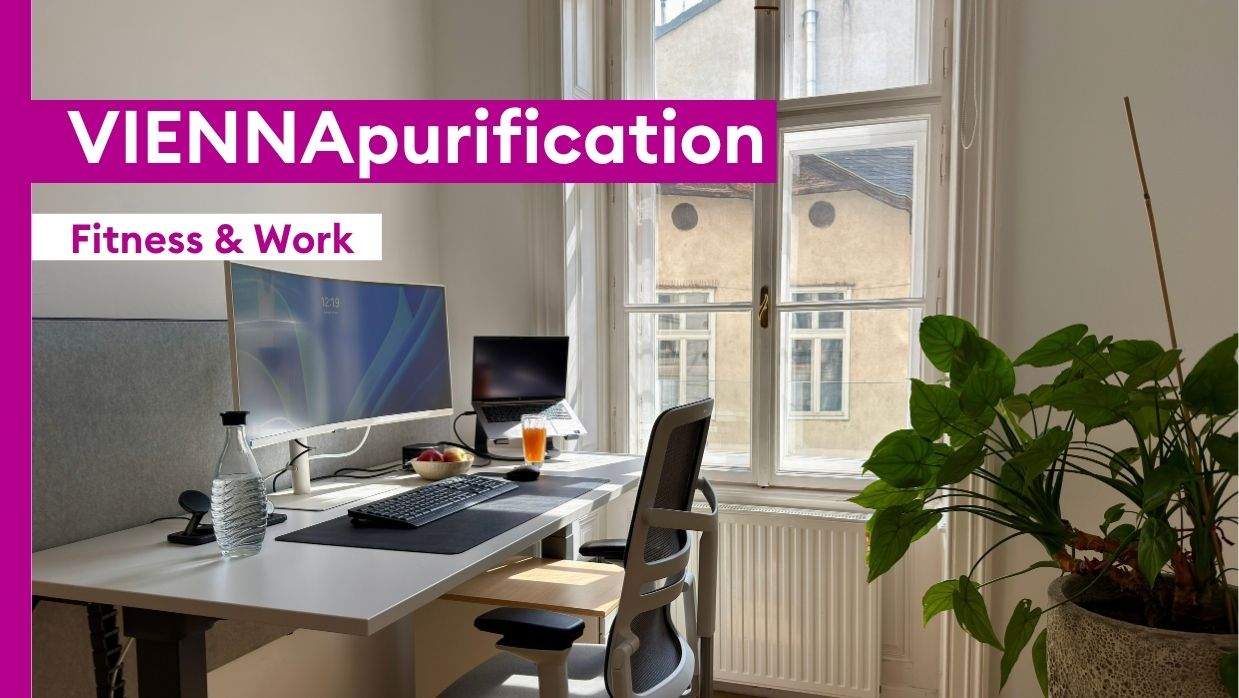
Consequently, ergonomic chairs are now part of our standard equipment for all workstations, which can be personally adjusted to suit the individual physical differences of our employees. To complement this, we have purchased height-adjustable desks and monitors with the corresponding ergonomic keyboards and mice. The aim was to create the basis for varied movement without requiring any additional effort. Our standing mats also provide further variety. These are designed to simulate an unstable surface, thereby gently activating the body whilst standing upright, which helps to strengthen the muscles, particularly in the spine and neck areas.
By creating a literally ‘active workplace’, we ensure the stability of work processes and can guarantee consistently better performance from our staff.
With these targeted measures to ergonomically customise the workplace, we avoid long-term issues such as loss of productivity and physical complaints.
Less is often more – take breaks
What may sound contradictory at first, as time is often equated with money, proves to be extremely effective on closer inspection. As a short-term solution, walking and standing breaks have a miraculous effect on body and mind.
A helpful approach for this is both practical and easy to implement: the so-called ‘40-15-5 rule’ – it works as follows:
- 40 minutes sitting
- 15 minutes standing
- 5 minutes walking
Especially with height-adjustable desks, such as those in our office, this dynamic can be easily incorporated into the daily work routine. Alternatively, you can also incorporate small routines throughout the day.
Here are a few tips:
Change your posture regularly, as there isn’t just one ‘correct’ position, it’s the variation that makes the important difference. Stand up, fetch a glass of water or a coffee, and whilst doing so, roll your shoulders and gently tilt your head from side to side to prevent your joints from stiffening. I’d also like to highlight the importance of staying hydrated throughout the day. The best approach is to keep a nice jug of water with slices of lemon or other fruit next to you at your desk and top it up with fresh water several times a day, this is often the easiest way to manage it.
But does it really make a significant difference if you take all these tips to heart? The answer is ‘yes’, because the rationale behind all these ‘exercises’ is easily explained. When the body is in motion, blood circulates more freely than when sitting still, resulting in better oxygen supply, including to the brain. It therefore makes sense to apply this rule, particularly when performing cognitively demanding tasks, to prevent fatigue setting in during the day.
As is so often the case, it is not the intensity but the frequency that is crucial to ensuring consistent progress and effective prevention.
We at vipur – what our daily lives look like
Especially at the start of spring, in combination with the New Year’s resolution, we’re still motivated to take better care of our bodies, but we’ve all surely found that these bursts of motivation often fade as the year goes on. That’s why it’s important to find simple, practical rules that can be integrated into our daily lives without major changes. As a company, we’ve been helped by the knowledge I, Simon Kratochvil, gained during my training as a state-certified sports instructor.
For us, the first step begins even before we start work, namely on the journey to the office. As soon as the weather permits, some of our staff cycle to work, and we provide bike racks at our office. These 20 to 40 minutes, depending on the route taken, serve not only as a commute but also as an active start to the day. Those who do not cycle to work can still achieve positive physical activity through small adjustments to their daily routine, such as taking the stairs instead of the escalator, getting off the underground one stop earlier and walking the rest of the way. It doesn’t matter how you get to work, as long as your chosen commute is used more consciously for physical activity.
In the office itself, we work with ‘movement anchors’. These are recurring moments in the working day that are used for active movement. To this end, we use, for example, the before mentioned 40-15-5 rule, walk or stand during phone calls, and remind each other to keep changing position to prevent muscles and joints from stiffening. Our aim is not to add more tasks to our schedule, as the day is limited for us too and time is our most precious asset.
Our aim is to incorporate micro-movements into our established workflows and automate movement patterns to bring about a noticeable change in the long term – for the body, the mind and the team.
See you next time and wishing you all the best and stay in motion,
Simon Kratochvil and the vipur team